
What AI delivers depends more on you than on AI
5 leadership perspectives on AI
5 stages · Working document, May 2026 · For C-level decision-makers
Introduction
The same AI tools produce completely different outcomes in two organisations. The difference isn't the technology. It's the leader's perspective. This model describes five leadership perspectives on AI (Denial, Control, Return, Embedding and Redesign), each with its own core stance, strength and shadow.
There are dozens of AI maturity models. They look at technology, data infrastructure, tooling, governance. Useful, but they miss something. They miss the leader.
Because the way a leader looks at AI determines how AI lands across the whole organisation. The same technology produces radically different outcomes depending on the perspective the leader operates from. Give two leadership teams the same AI tools, and you get two completely different organisations.
This model is inspired by Frederic Laloux's Reinventing Organizations, which describes how organisations develop along stages. It's not a one-to-one translation. Where Laloux looks at organisational development in general, this model looks specifically at how leaders relate to AI. Every stage has its strength and its shadow. The point isn't to climb “up” as fast as possible, but to see honestly where you stand.
The model describes five stages. Each has a core stance, typical patterns you recognise in practice, a metaphor, and an analysis of strength and shadow. There is no “right” or “wrong.” A leader in stage 2 (Control) who makes that choice deliberately because the organisation needs safety first operates more effectively than a leader who claims Redesign but in practice decides everything themselves.
Stage 01 · Denial
Denial
“AI? That's not something we're into.”
Core stance
This stage has two faces. One is active: the leader experiences AI as a threat: to jobs, to control, to the way things have always been done. The reaction is rejection. The other face is quieter and far more common: AI simply isn't on the agenda. No fear, no resistance, but no urgency either. The topic never comes up in management meetings, no one thinks about it, there is no opinion. Not because waiting was a deliberate choice, but because it isn't seen as relevant.
Both variants come from the same place: a lack of first-hand experience with AI. The leader who actively rejects it bases that on headlines and sensational examples. The leader who stays passive has simply never looked at it seriously. In both cases the basis for a considered choice is missing.
How to recognise it
“AI? That's for tech companies, not for us.”
The leader places AI outside their own world. Their own work is seen as fundamentally different: too human, too complex, too specific for AI. Sometimes that's partly true, but the conclusion that AI therefore doesn't matter is not.
“It's not on our roadmap.”
Not active rejection, but quiet absence. AI doesn't appear in the annual plan, not in the strategy session, not in team meetings. Not because it was deliberately parked, but because no one puts it on the table, or because the person who did wasn't taken seriously.
Buying on impulse, without a plan.
The flip side of denial is panic. A competitor launches something with AI, the board asks questions, and suddenly a tool is bought or a consultant hired. No strategy, no ownership, no thought about what it should deliver. A few weeks later it disappears from the agenda again.
Decision-making
There is no decision-making about AI, because there is no conversation. In the active variant the leader decides alone (“we're not doing this”). In the passive variant nothing is decided. The topic never reaches decision-making. Employees who do want to experiment run into indifference, which blocks just as effectively as active resistance.
Human–AI relationship
Human vs. AI · or: human without AI
In the active variant AI is seen as an opponent, something that threatens jobs or undermines the human element of work. In the passive variant that relationship simply doesn't exist. AI is absent, invisible, irrelevant.
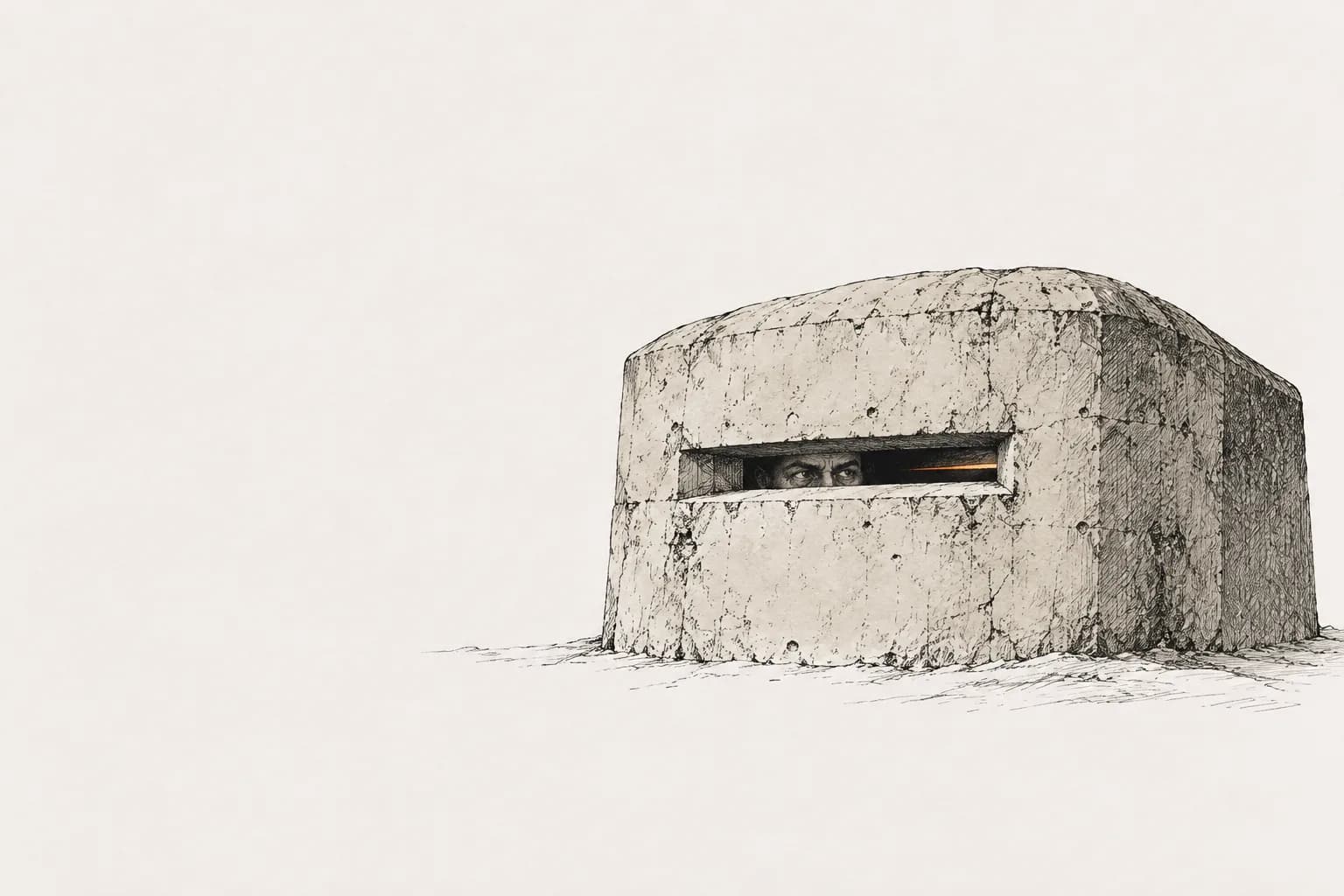
Metaphor: The Bunker
In the active variant: doors shut, hoping the storm blows over. In the passive variant: there is no bunker, because there is no storm. At least, that's what the leader thinks. The problem in both cases: it isn't a storm. It's climate change.
Strength
This stage sometimes rightly protects the organisation against hype-driven haste. Not everything labelled AI is good, not every tool delivers on its promise, and a critical stance toward technological hype has value. The passive variant has a functional side too: not every organisation has to move first. Sometimes waiting is rational, provided it's a conscious choice.
The healthy core of this stage, a critical eye and the ability not to follow every hype blindly, is something you must carry into every following stage.
Shadow
The world changes, and the organisation loses touch. Not tomorrow, but gradually. In active denial, the employees who do want to experiment leave. In passive denial it's more insidious: no knowledge develops, no experience, no feel for what AI can and can't do. Every future decision about AI is made from ignorance rather than experience.
The treacherous thing about the passive variant is that no one sees it as a problem. There is no conflict, no resistance, no signal that something is missing. Until the market moves, until customers have expectations, until employees leave for organisations that do move. By then the gap isn't months but years.
Stage 02 · Control
Control
“AI is allowed, as long as it's under control.”
Core stance
The leader acknowledges that AI exists, but approaches it primarily as a risk to be managed. AI adoption is framed in terms of policy, compliance and governance. There's an AI policy, a steering committee, an approval process. Safety and predictability are central.
This stage is common in organisations in regulated sectors (financial services, healthcare, government) but also among leaders who are risk-averse by nature. The underlying conviction is that AI may only be deployed once all risks have been mapped and all frameworks are in place.
How to recognise it
“We need an AI policy first before anyone can work with it.”
Policy becomes the precondition for action. In practice, making that policy takes months, sometimes longer, and by the time it exists the technology has changed.
“This has to go through legal, IT and the works council first.”
Every AI initiative is routed through multiple approval layers. The result is that only the safest, least innovative applications make it through.
One approved tool, strictly regulated.
The organisation picks one AI tool (often the safest option, not the best) and regulates its use down to the detail. Who may use it, for what, with which data, and who checks that.
Decision-making
Top-down. The steering committee decides. Individual experimentation is discouraged or explicitly forbidden. There's a clear hierarchy: IT or compliance determines what's technically allowed, leadership determines what's strategically desirable, and employees execute.
Human–AI relationship
Human above AI
AI is a subordinate force that may only operate once the human has set all the frameworks. The human remains in control at all times.
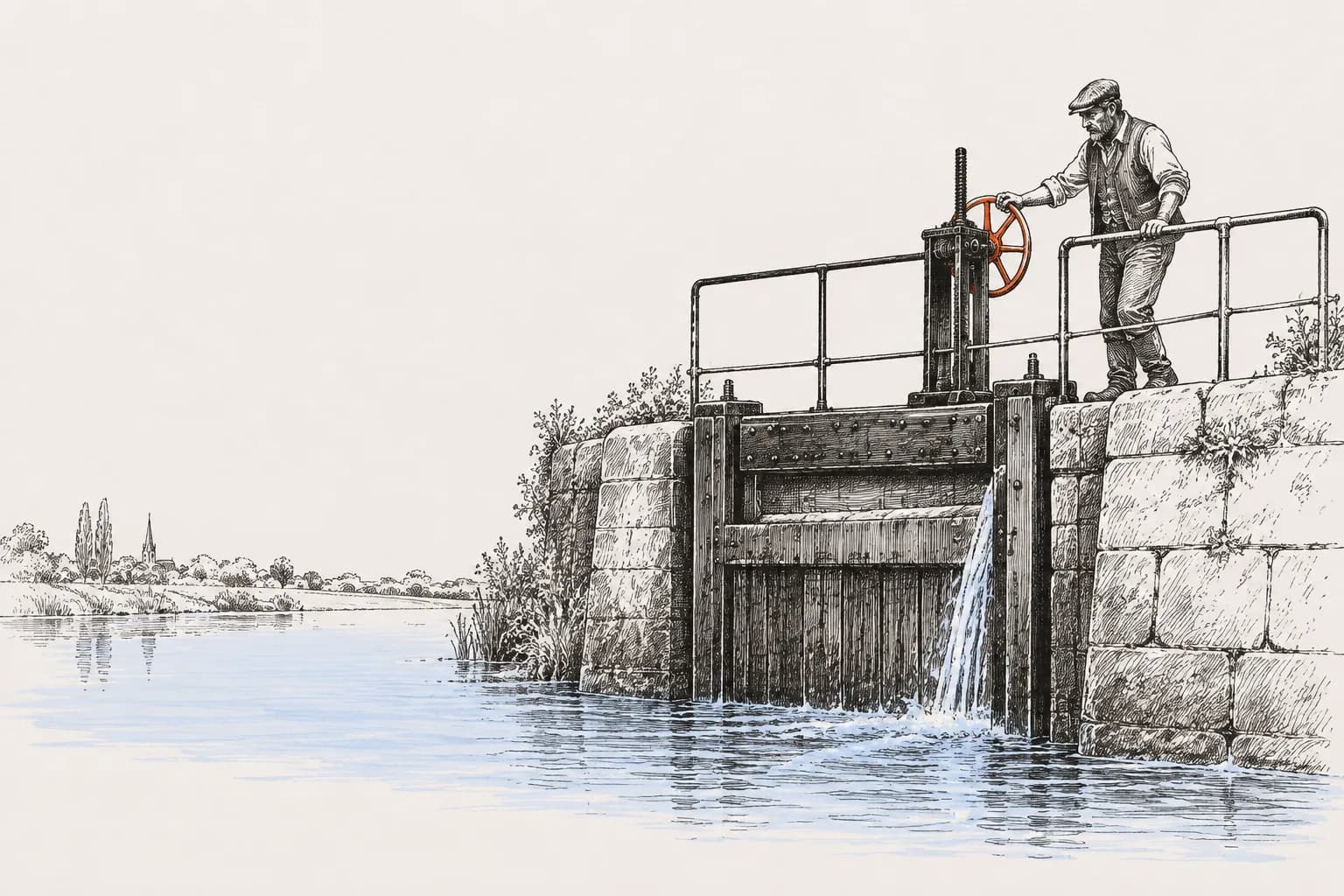
Metaphor: The Lock System
Everything has to go through the right channel, in the right order. The water flows eventually, but slowly and only where the lock-keeper allows it.
Strength
This stage creates safety and clarity. It prevents naive data leaks, ethical slip-ups and reputational risks. For organisations working with sensitive data (patient records, financial data, personal data), a phase of deliberate control isn't a luxury but a necessity. The problem isn't the existence of this stage, but getting stuck in it.
Without this foundation of safety and governance, every following stage becomes vulnerable. An organisation that overshoots into Return without solid frameworks creates risks that can later block the entire AI adoption.
Shadow
Policy becomes an end in itself. The steering committee meets, the policy is updated, the risk analysis is repeated, but little happens. By the time the organisation is “ready,” the market has moved three generations of tools further.
And then there's shadow AI: employees who find the official tools too slow, too cumbersome, and start using ChatGPT or other tools on their own. Out of IT's sight. Outside the policy's framework. Exactly the risk the policy was meant to prevent.
Stage 03 · Return
Return
“AI has to pay off.”
Core stance
This is the stage where most organisations are now, or are moving toward. AI is approached as a productivity tool. The leader thinks in business cases, ROI, FTE savings and competitive advantage. Pilots are run, KPIs are set, and there's a clear expectation: AI has to deliver measurable results.
It's the stage of the management consultant, the board presentation, the quarterly report. AI is no longer a subject of denial (stage 1) and no longer a risk to be managed (stage 2). It's a lever. A means to do the same things faster, cheaper or better.
How to recognise it
“How many FTE does this save?”
The first question for every AI initiative is the business case. What does it cost, what does it deliver, when is the investment recouped. Projects without a clear ROI don't get approved.
“We'll run a pilot in Q2, and then we'll measure the impact.”
AI is approached as a project: defined in scope, time and budget. There's a project team, a steering committee, a go/no-go moment. The language is that of project management.
Center of Excellence, AI task force, innovation lab.
AI gets a place in the organisation, but that place is fenced off. There's a team that “handles AI,” and the rest of the organisation waits for that team to come up with solutions.
Decision-making
Data-driven, top-down steered with delegated pilots. Management by Objectives, but for AI. Leadership sets the direction, the CoE translates that into initiatives, the teams execute. Success is measured in hard numbers: lead time, cost per transaction, customer satisfaction scores.
Human–AI relationship
Human drives AI
The human is the driver, AI is the instrument. The relationship is functional. AI does what it has to, no more. The human defines the task, AI executes, the human judges the result.
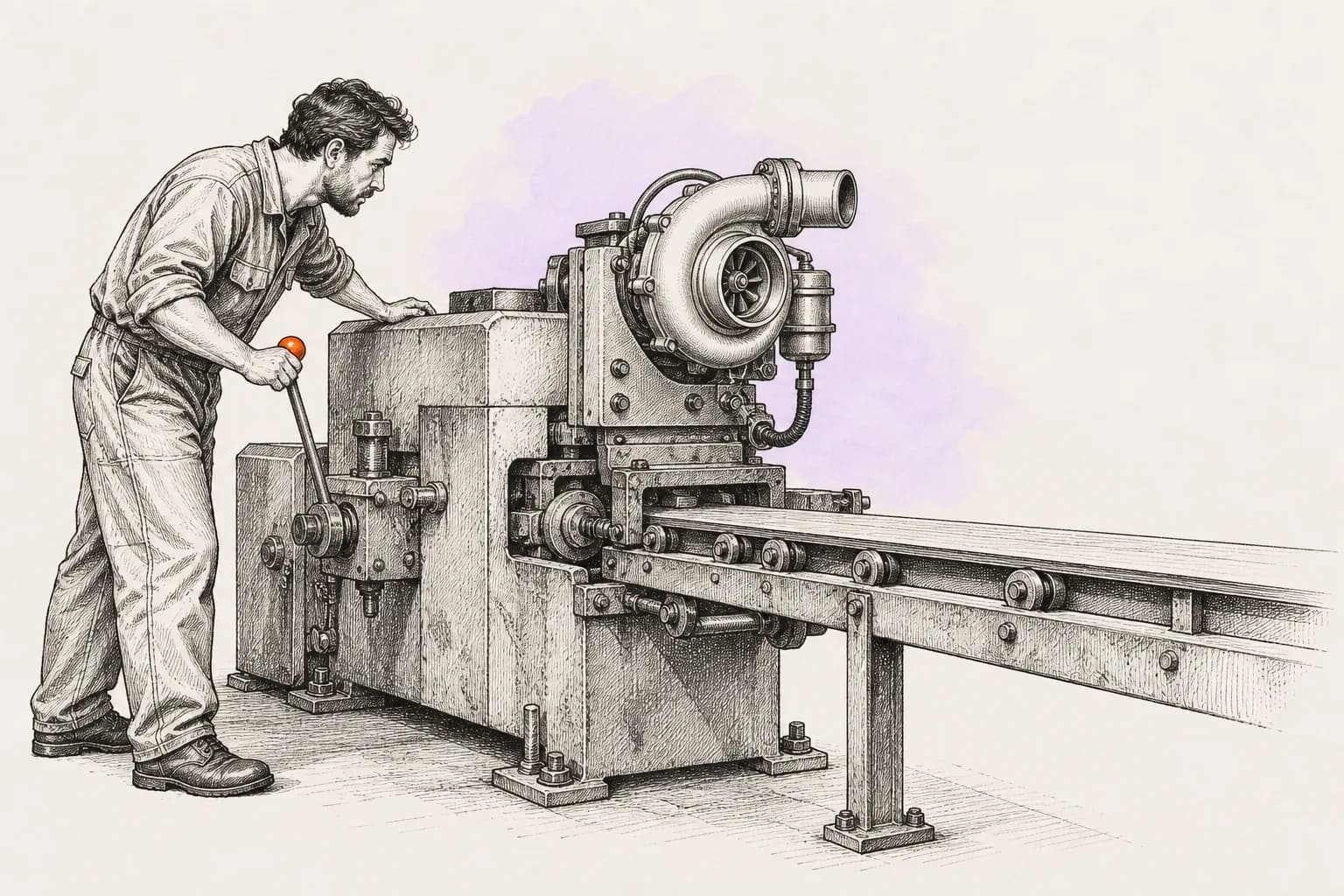
Metaphor: The Turbocharged Machine
The same organisation, but faster and more efficient. The processes don't change fundamentally, they're accelerated. The org chart stays the same, the meeting structure stays the same, the way of working stays the same. There's just a turbo on it now.
Strength
This stage makes AI concrete and measurable. It creates momentum, shows that it works, and builds a track record that justifies further investment. Organisations at this stage often have impressive results to show: 40% faster lead time here, 60% fewer manual errors there. Those results are real, and they're valuable.
That discipline of measuring, proving and accounting for is what you carry into Embedding. Without proven results, broad adoption is an article of faith rather than a substantiated case. The track record of this stage gives the rest of the organisation the confidence to move along.
Shadow
Everything has to pass through the lens of return. AI initiatives that don't fit a business case don't get started. That sounds rational, but it excludes a lot. The insight an employee gains from sparring with AI about a complex problem has no ROI. The shift in how a team collaborates when routine work falls away doesn't appear in a spreadsheet. The new questions that arise when you look at data differently don't fit a quarterly report. That value is real, but it's ignored because it isn't measurable.
Employees become “users” of a tool rather than co-shapers of a new way of working. They execute what the CoE devises, within the boundaries management sets. Their own ideas about what AI could mean for their work aren't asked for, or disappear into a backlog that's never picked up.
And when the ROI disappoints, which happens with many pilots because expectations are often unrealistic or the implementation is scoped too narrowly, attention fades again. AI then becomes a “disappointment” rather than a learning experience.
Stage 04 · Embedding
Embedding
“AI is in everything we do.”
Core stance
At this stage AI is no longer a project and no longer a department. It's everywhere. Customer service uses it, finance uses it, HR uses it, the warehouse uses it. Not because management rolled it out, but because employees embraced it themselves. AI has become part of how the organisation works, as self-evident as email or a CRM system.
The difference from stage 3 (Return) is that AI no longer depends on a central team or task force. There's no longer a need for a CoE to select use cases and guide pilots. Teams find applications themselves, share what works, and build on each other's experiments. AI is embedded in daily practice.
But, and this is the point, the organisation itself is still the same. The structure is the same, the roles are the same, the business model is the same. AI has accelerated and improved the work, but hasn't fundamentally changed how the organisation is set up. That's both the strength and the limitation of this stage.
How to recognise it
“Everyone here uses AI.”
And it's true. Not as a PR story, but as daily reality. From leadership to the shop floor. Not equally intensively everywhere, but the threshold is gone. People talk about AI applications the way they talk about Excel tricks: casually, between colleagues, as part of the work.
“There's no AI team anymore.”
Or the team still formally exists, but in practice AI knowledge is spread across the whole organisation. Champions share their expertise, new employees learn it from colleagues, and keeping up with AI developments is no longer the task of one department but a shared responsibility.
AI no longer comes up as a separate agenda item.
In stage 3, AI is a standing agenda item: pilot status, ROI reporting, next steps. In stage 4, AI disappears as a separate topic. It's woven into every conversation about work processes, customer contact and product development. You don't discuss AI separately, just as you don't discuss “phone usage” separately.
Decision-making
Decentralised. Teams decide for themselves how they deploy AI. There are frameworks (around safety, data, ethics) but within them teams have the freedom to experiment and apply. The leader no longer has to make or approve every AI decision. That was still necessary in stage 3; here it isn't.
Human–AI relationship
Human with AI
Employees have developed their own relationship with AI. They know where it helps and where it falls short. They have their own workflows, their own prompts, their own way of collaborating with AI. It's no longer the company's tool. It's their tool.
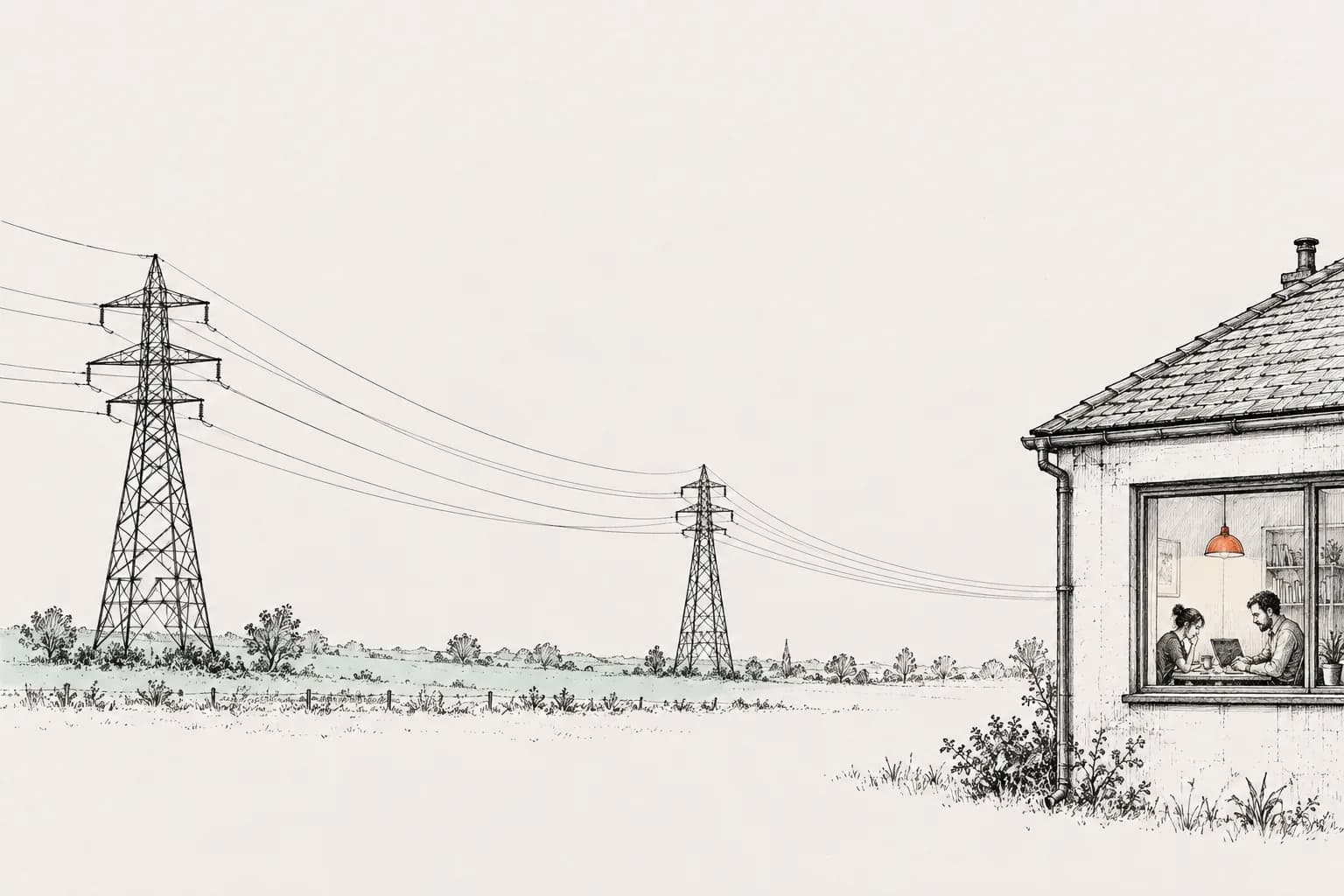
Metaphor: The Power Grid
AI is in every wall of the organisation. Everyone uses it, no one thinks about it anymore. You switch it on, it works, it's just there. But the house itself is still the same. The same rooms, the same layout, the same occupants. The power grid hasn't changed the house, only made it more comfortable.
Strength
The organisation gets more out of AI than any centrally steered programme could have achieved. Employees find applications management never thought of. Learning is fast because it happens in parallel in every team. And there is ownership: people use AI not because they have to, but because it makes their work better.
That ownership has a flip side that's also a strength: the organisation is less fragile. If one AI tool falls away or a vendor stops, teams find alternatives themselves. The knowledge isn't in a system or with one department, but with the people. That makes the organisation resilient.
This broad ownership is the precondition for Redesign. An organisation can only reinvent itself if its people know AI well enough to think along about how their work could look fundamentally different. Without that broad experience, redesign is a top-down reorganisation, not a shared transformation.
Shadow
AI is everywhere, but the organisation is still the same. The same hierarchy, the same roles, the same way of collaborating. Everyone works faster and smarter, but no one asks the question: if AI can do so much of our work, why do we still have the same roles? Why is our org chart unchanged?
In practice, sprawl also emerges. Every team uses different tools, different prompts, different workflows. There's no shared standard, no knowledge retention, no overview of everything happening with AI. The CISO watches with growing unease. So does the compliance officer. The freedom that makes this stage so powerful also becomes a governance challenge.
The deeper risk is optimising the existing. The organisation becomes very good at doing more efficiently the things that maybe no longer need doing at all. Why change something that works? That exact question is the threshold to stage 5.
Stage 05 · Redesign
Redesign
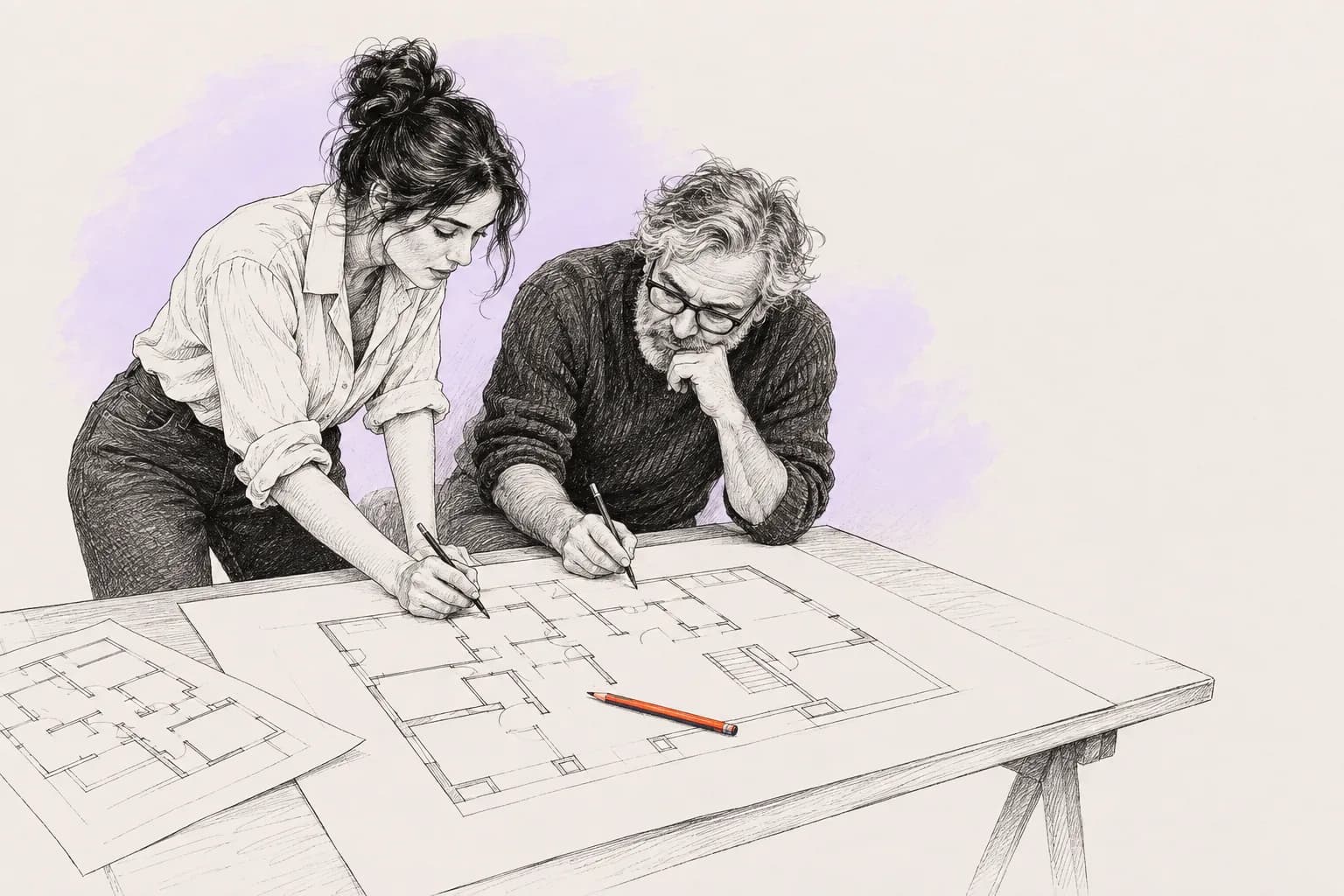
“If AI can do all this, why are we still organised this way?”
Core stance
This is the stage where the leader asks a fundamentally different question. Not “how do we deploy AI?” but “if AI can do this much, what does that mean for how our organisation looks?” The leader no longer sees AI as something that strengthens the existing, but as something that calls the existing into question.
In stage 4, AI was embedded in the organisation, but the organisation itself stayed the same. In stage 5, the organisation changes. Roles are redefined. Teams are composed differently. Processes aren't optimised but redesigned. Perhaps the business model changes. The leader realises that an organisation built for a world without AI can't be the same organisation as one built for a world with AI.
How to recognise it
“We no longer have a customer service department in the old sense.”
Roles that ran entirely on tasks AI now does have been abolished or radically changed. Some people get a new role: the customer service rep becomes a relationship manager, the controller becomes a strategic data analyst. But not everyone fits the new design. That's the uncomfortable reality of this stage.
“The org chart has changed beyond recognition.”
Not through a reorganisation in the classic sense (moving boxes, removing layers) but through a fundamentally different view of how work is divided. Teams are smaller, with broader mandates. Specialist departments give way to multidisciplinary teams that, with AI, can do more than old departments with three times as many people.
The business model has shifted.
The organisation does things that were impossible five years ago. Not because the technology wasn't there, but because no one had imagined that with a team of 10 people and AI you could do what used to take 50. Or that you could offer a service you previously couldn't deliver, because the analysis was too complex for people alone.
Decision-making
The leader steers on direction, not on structure. Decisions about how the organisation is set up are continuously reconsidered based on what AI makes possible. That sounds chaotic, but it's the opposite: it's an organisation that consciously chooses how it's set up rather than clinging to structures that once made sense but no longer do.
Human–AI relationship
Human and AI as partners in a new design
The question is no longer who does what, but how you combine human and AI so that the whole is more than the sum of its parts. People do what people do well: judging, building relationships, making ethical trade-offs, thinking creatively. AI does what AI does well: recognising patterns, processing large volumes of information, executing consistently, being available 24/7. The redesign is about the optimal combination.
Metaphor: The Drawing Board
The organisation goes back to the drawing board. Not to polish up the existing, but to redesign from the question: if we started today, with everything AI can do, how would we organise ourselves? The answer rarely looks like the current org chart.
Strength
This is where AI reaches its full potential. Not as an accelerator of the existing, but as an enabler of the new. Organisations at this stage can do things their competitors can't, not because they have better AI tools, but because they've set themselves up differently around what AI makes possible. They aren't faster at the old game; they play a different game.
Shadow
Redesign is disruptive. Not everyone can or wants to come along. The roles that disappear aren't abstract. They're people with mortgages and families who are told their job is fundamentally changing. The leader who embraces this stage without regard for the human impact makes the same mistake as the stage-3 leader who only looked at ROI: reducing people to variables in a spreadsheet.
There's also the risk of redesign as an end in itself. Reorganising because you can, not because you must. Tearing down structures that worked perfectly well, because the leader is fascinated by AI's possibilities. The discipline to distinguish what truly must change from what works fine as it is. That may well be the hardest skill at this stage.
Recognise your organisation in one of these five? Then the next question is not which stage it is, but what the next step takes.
Book a 30-minute callOverview: what changes per stage
The table summarises the five stages along seven dimensions. Use it as a cheat sheet, not as a diagnostic instrument.
| Dimension | 01 · Denial | 02 · Control | 03 · Return | 04 · Embedding | 05 · Redesign |
|---|---|---|---|---|---|
| Core question | Is this even relevant to us? | How do we keep this safe? | What's the return? | How do we make AI part of everyone's work? | What should change now that AI can do this? |
| AI ownership | No one (or the leader alone) | IT / Compliance | AI task force / CoE | Everyone, as a matter of course | Woven into the org design |
| Human–AI relationship | Human vs. AI, or: human without AI | Human above AI | Human drives AI | Human with AI | Human and AI as partners in a new design |
| Leadership role | Absent or acting on impulse | Regulating and guarding | Steering on results | Setting boundaries, letting go | Reinventing the organisation |
| What the leader says | “AI? We're not discussing that right now” | “Do we have a policy for this yet?” | “What's the business case?” | “Everyone here works with AI” | “Why do we still have this department?” |
| Biggest risk | Falling behind without noticing | Policy that suffocates innovation | Only measuring what's measurable | Optimising the wrong things | Reorganising without regard for people |
| Metaphor | The Bunker | The Lock System | The Turbocharged Machine | The Power Grid | The Drawing Board |
Working with the model
Key starting points
Not a ladder, but a landscape
The model describes five stages, but that doesn't mean “up” is always better. An organisation just starting with AI that deliberately chooses a phase of control (stage 2) acts more wisely than one that claims stage 5 but centralises every decision in practice. It's not about where you sit, but whether that fits where your organisation is now.
Leaders are not their organisation
Many leaders personally sit at a different stage than their organisation. A director who is at Embedding (stage 4) but leads a Return organisation (stage 3) feels daily tension. That tension isn't necessarily bad, but you have to see it and be able to work with it. The gap between where the leader sits and where the organisation sits is often the most interesting conversation.
Each stage builds on the previous one
You can't skip a stage. The healthy side of each stage is a precondition for the next. Without the safety of Control, Return becomes reckless. Without the measurability of Return, Embedding becomes non-committal. Without broad embedding in the organisation, Redesign becomes a boardroom exercise no one follows. Growth doesn't mean leaving the previous stage behind, but carrying its strength forward.
The shadow is the real work
Every stage has a shadow side. The question “which shadow do you recognise in yourself?” is more powerful than “which level are you at?” Growth isn't in claiming a higher stage, but in honestly seeing your own shadow.
Facilitator's guide
This model is built for conversation, not diagnosis. Below are four formats we use in SPAIK sessions.
Self-positioning
Have participants individually answer two questions: “Where do you sit as a leader?” and “Where does your organisation sit?” The gap between those two positions is where the conversation begins.
Exploring the tension
Have groups of 3-4 discuss the tension between their personal position and their organisation's. Where do you feel that tension? What do you do with it? What would change if you saw that tension as information rather than as a problem?
Shadow work
Have participants choose: which shadow do you recognise most in yourself? Not in your organisation, not in your colleagues, but in yourself. This is the most vulnerable part, and therefore the most valuable.
Direction of movement
Have participants formulate one concrete action: what is the logical next step, and what will I do differently tomorrow?
Examples of a direction of movement
From Denial to Control
“Next week I'll spend 2 hours working with an AI tool myself.”
From Control to Return
“I'll approve one pilot without the full governance process.”
From Return to Embedding
“I'll give three people outside the AI team the mandate to experiment on their own.”
From Embedding to Redesign
“I'll ask the question: which roles would we set up differently if we started over?”
Background
This model was developed by SPAIK on the basis of practice: dozens of conversations with C-level decision-makers and leadership teams about AI adoption. The direct inspiration is Frederic Laloux's Reinventing Organizations (2014), which describes how organisations develop along stages of perspective. Laloux builds on the work of Clare Graves (Spiral Dynamics), Ken Wilber (Integral Theory) and Robert Kegan (adult development).
This model is intended as a working document, not as a scientifically validated instrument. It's a conversation tool: a way to help leaders reflect on their own relationship with AI, and to translate that reflection into concrete action.
Frequently asked questions
- What determines the outcomes AI delivers in an organisation?
- Not the technology, but the leader's perspective. The same AI tools produce completely different outcomes in two organisations, depending on how the leader views AI.
- What are the five leadership perspectives on AI?
- Denial, Control, Return, Embedding and Redesign. Each perspective has its own core attitude, a strength and a shadow.
- Is a higher stage always better?
- No. Every stage has both a strength and a shadow. It's not about climbing up as fast as possible, but about honestly seeing where you stand and consciously choosing what the organisation needs now.
- What is the model based on?
- It's inspired by Frederic Laloux's Reinventing Organizations, focused on how leaders relate to AI. Laloux builds on Clare Graves (Spiral Dynamics), Ken Wilber and Robert Kegan.
- Who is this whitepaper for?
- C-level decision-makers and leadership teams who want to understand why the same AI investment plays out differently for them than elsewhere, and what role their own perspective plays in that.
Download the whitepaper
The full whitepaper as a PDF: all five stages, the overview table and the facilitator's guide in one document to share or print. The PDF is in Dutch (the original).
Want to talk about where you stand?
Jan Bolle is an economist and organisational psychologist specialising in organisational development and leadership. At SPAIK he leads the organisational side of AI adoption.
Questions, feedback or experiences with the model? Get in touch.
Organizational Transformation, SPAIK · Coach for C-level decision-makers
From perspective to practice: turning a leadership stance into AI that actually sticks is what our AI adoption programme is built for.