Blogs
Becoming AI-ready without replacing your entire IT landscape
Jochem van Laren - CEO
"We must first modernize our entire infrastructure before we can start with AI."
We hear this often. It is the biggest misconception about AI-readiness: that it has to be a major change. That you must first connect systems, clean up data, document processes.
In reality, you can simply start small. Learn. And gradually expand those lessons across the organization.
Start in the bottom left corner
We use a simple model to determine where AI fits in an organization. Two axes: task complexity and human value.
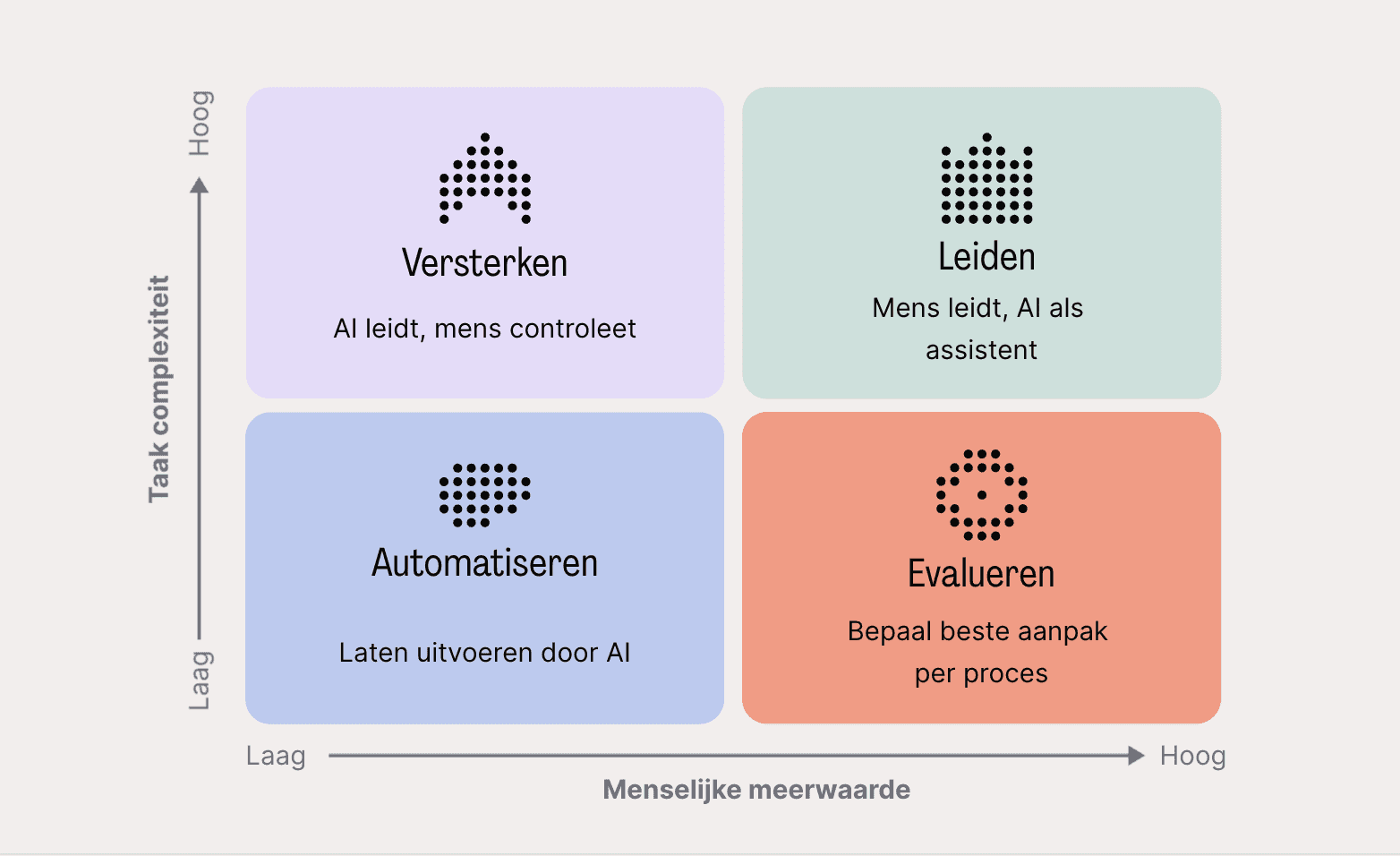
Automate (low complexity, low human value)
Let AI perform. This is where you start.
Augment (high complexity, low human value)
AI leads, human controls.
Evaluate (low complexity, high human value)
Determine the best approach for each process.
Lead (high complexity, high human value)
Human leads, AI as an assistant.
With clients, we always start at the bottom left. Automate. The simple, repetitive tasks where people currently spend time without adding much value. These are the first steps.
Why invoicing is often the first step
At a real estate company, we started with the invoicing process. Not because it's exciting, but because it met three criteria:
Business rules already existed
Everyone knew what an invoice should look like. The rules were somewhere, even if it was in someone's head.
Good examples were available
Hundreds of past invoices. Good and bad ones. Enough to learn from.
Quality could be objectively checked
An invoice is either correct or not. Binary. No debate over whether it's "good enough."
This is also why coding is one of the most applied AI areas in companies. It's binary: the code works or it doesn't. No interpretation needed. McKinsey's research confirms this: software development is one of the areas with the highest AI impact.
If you're looking for where to start, look for processes with the same characteristics. Clear rules. Available good examples and controllable quality output.
But our systems don't communicate
We hear this often. Legacy systems that aren't integrated. Data in silos. No central place where everything comes together.
The solution is not to replace or integrate all those systems. That takes years.
What we often do: build a layer on top of the existing systems. A kind of AI database where everything comes together, independent of the systems. That layer smartly communicates with the existing legacy systems.
Your existing systems keep running. The AI collects what it needs, without you having to overhaul your entire infrastructure.
But our data is a mess
This may be the most interesting objection. Because it's often true. Data is messy, inconsistent, spread across systems.
But here's the thing: there was never a real ROI in organizing the data. Cleaning up took time and money, but what did it yield? Hard to say.
With AI, there is an ROI.
Now you can say: if we clean up this data, AI can automate this process, and we save X hours a week. Concrete. Measurable. A business case.
So "our data is a mess" is not a reason to wait. It's actually a reason to start. AI finally gives you an argument to clean that data up.
The conversation that arises
Something interesting happens when you start automating. The conversation shifts.
Not: "AI will take over our jobs."
But: "Hey, my people can do more."
When the simple, repetitive tasks drift away, space opens up. And then the question becomes: where do we place people where they truly add value? Where is the human value?
This makes it a completely different conversation. Not threatening, but enabling. Not fewer people, but people in the right place.
The absolute minimum to start
What do you really need?
A well-defined process
Not your entire organization. One process. Clear start, clear end. Preferably something where people currently do repetitive work.
Enthusiastic people
You can progress faster with a few enthusiasts who have the space and freedom than with an entire project team that must.
That's it. No new systems. No months of preparation. No perfect data.
By starting small, you learn:
How AI works in your context
What is needed in terms of data and input
How to standardize a process
How to define and check quality
What tools work for you
What can and can't be done with your current systems
You then spread those lessons across the organization. Not the other way around.
Making it measurable
One more thing: start with a baseline measurement.
How much time does this process currently take? How many errors are there? What is the lead time?
Without that baseline measurement, you can't prove later what it yields. And without proof of effect, AI remains an experiment instead of a new way of working.
You don't build trust in AI with promises. You build it with numbers.
Frequently Asked Questions
Do we need to link our systems first before we can start?
No. You can build a layer on top of your existing systems that communicates intelligently with them. Your legacy systems just keep running.
Our data is not organized. Is that a problem?
It's actually a reason to start. AI gives you the first concrete ROI on cleaning up data. Start small, and clean up what you need for that one process.
Where should we start?
Look for a process with three characteristics: clear rules, available examples, and objectively checkable output. Often these are administrative processes such as invoicing, order processing, or reporting.
How many people do we need to start?
A few enthusiastic people with a well-defined process is enough. You learn more from starting small than from big planning.
Want to know where your organization can start? Let's talk - through a Tech & Data Assessment we will map out together which processes are suitable for AI—and what you minimally need to get started.